


Falling birth rates reveal a deeper social problem: many people who want children feel blocked by economic, housing, gender, and climate pressures.
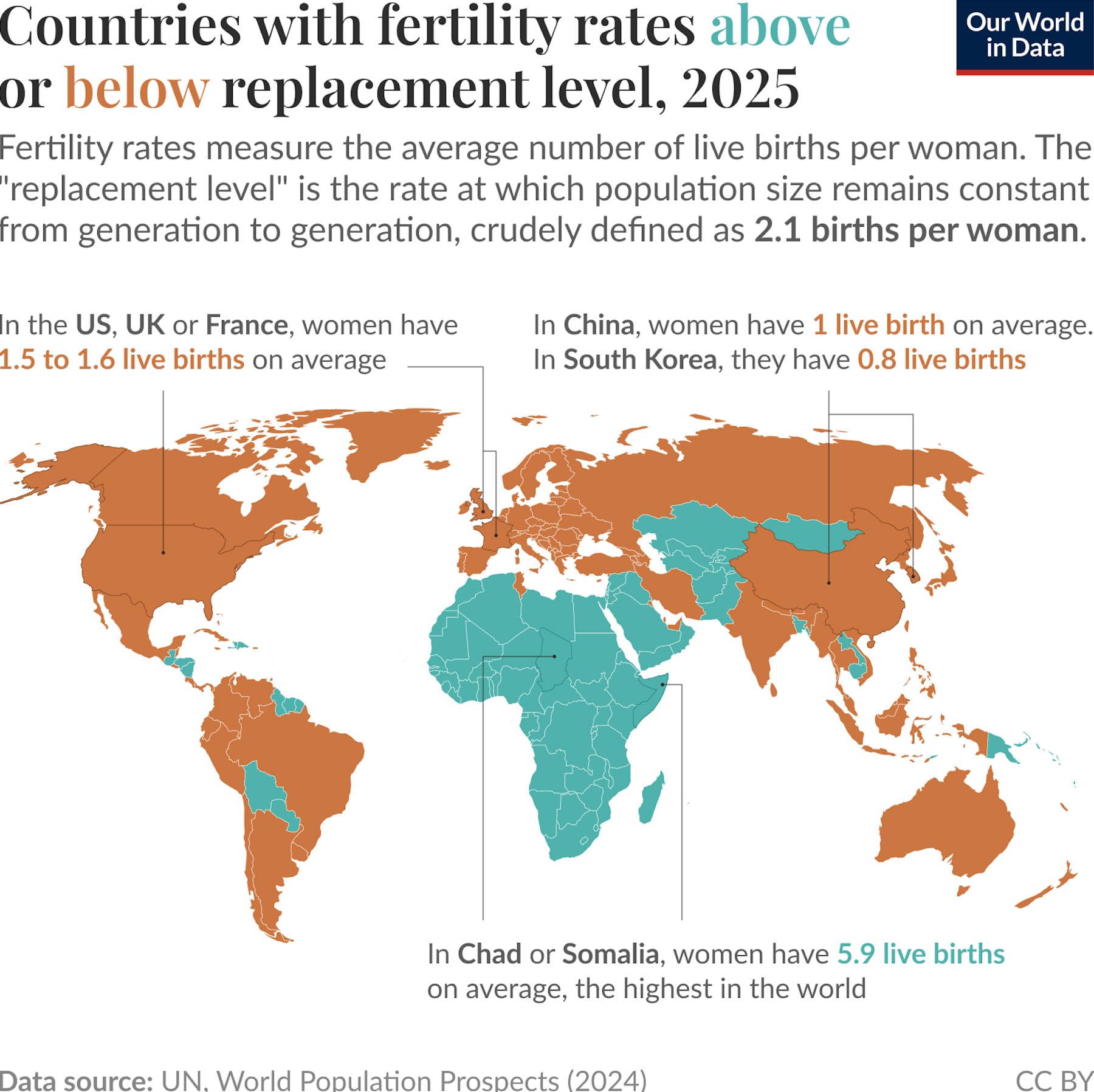
Birth rates have been falling around the world since the height of the baby boom that followed the Second World War. In many places, including Australia, they are now below replacement level. In simple terms, average populations are no longer having enough children to replace themselves over time.
Declining total fertility (or birth) rates, meaning the average number of births per woman, have drawn comments from figures ranging from Elon Musk to Italian Prime Minister Giorgia Meloni and the pope.
Since the 1960s, public debate has often focused on the dangers of overpopulation. Those concerns have not disappeared, especially in discussions linked to immigration, but attention has increasingly turned toward shrinking populations and the economic and national security challenges they may bring.
Overpopulation fears to depopulation woes
In his 1968 book The Population Bomb, Paul Ehrlich warned the 1970s would bring “people, people, people, people” and an overpopulation “cancer” resulting in famine and war. Human extinction was imminent, we were warned.
The predicted extinction of humanity from overpopulation has not happened.
Since 1950, the global total fertility rate has dropped by more than half. Across OECD countries, the average birth rate is now 1.46 births per woman, far below the 2.1 births per woman generally needed for one generation to replace the next.
World population decline is projected by the mid-2080s. China is now in its fourth year of population decline. South Korea has been declining since 2019 with its near-global record low birth rates. Germany has seen deaths outnumber births since 1972. Japan, Greece, Italy, Cuba, and Thailand are also among those in the depopulation club.
Without immigration, the United Kingdom would also see population decline, with deaths outnumbering births. Australia is about a generation away from the same fate. Immigration controls have seen depopulation in Canada.
Birth rates a solution to the aging ‘problem’
Enormous advancements since the 1950s, mostly in health and medical technologies like immunization, mean humans are living longer. We’re also having fewer children, and as a result, populations are aging.
An aging population is a mark of success and human ingenuity, but economic systems tend to view aging societies as problematic.
Workers and working-aged people are essential to maintain a healthy economy. Individual income taxpayers are the top source of federal government revenue in Australia. Too few people of working age replacing those retiring can seriously undermine economic well-being, forcing governments to do more service provision with less financial resources.
Below-replacement fertility and its implications for government bottom lines have resulted in Australian politicians calling on Australians to have more babies. “Have one for mum, one for dad, and one for the country,” Treasurer Peter Costello famously said in 2004.
In 2020, former prime minister Tony Abbott suggested the wrong kind of women were having children, calling on “middle-class” women to have more. Talking about the budget, Treasurer Jim Chalmers in 2024 said it would be “better if birth rates were higher.”
Human catastrophe of low birth rates
People are increasingly saying the choice to have children is constrained by external factors. Worldwide, around one-in-five surveyed by the United Nations said fears about the future would or have resulted in them having fewer children than they wanted.
Housing affordability, economic stability, gender inequality, and climate change present insurmountable barriers for having a much-wanted family.
The lack of choice to have children in below-replacement regions, I’d argue, is indeed a human catastrophe. How is it that we’ve allowed society to become so hostile that children are out of the question for so many who want them?
The intergenerational bargain is well and truly corrupted.
We are confronted with the tough question of who will care for us if the children are gone.
Can a human catastrophe be avoided?
The burden of having a family falls on working-aged people, especially women.
A baby bonus or one-off payment is unlikely to change people’s minds and increase the total fertility rate; such payments merely change timing. Instead, increasing total fertility rates requires a comprehensive suite of measures from a policy perspective.
Tackling the big four domains of housing, the economy, gender, and climate encompasses issues such as
- secure, affordable, and appropriate housing
- employment and income security
- accessible childcare
- social and workplace gender equality
- climate change action.
People of childbearing age aren’t being hedonistic when making family and fertility decisions. They’re not thinking about themselves, they’re actually thinking about the future world and weighing what that might look like for prospective children.
Loss of hope among people of childbearing age, including fears of being left behind, contributes to overall concerns about an insecure future.
Not only is the human catastrophe of low birth rates reflecting more widespread concerns, such as insecurity, it could also be undermining social cohesion.
Rather than an exploding bomb of overpopulation, the world faces an economic and social implosion due to a lack of substantive support necessary to help raise much-wanted children.
Surely it’s beyond time we ask people what they actually need – and give it to them.
Adapted from an article originally published in The Conversation.
Never miss a breakthrough: Join the SciTechDaily newsletter.
Follow us on Google and Google News.